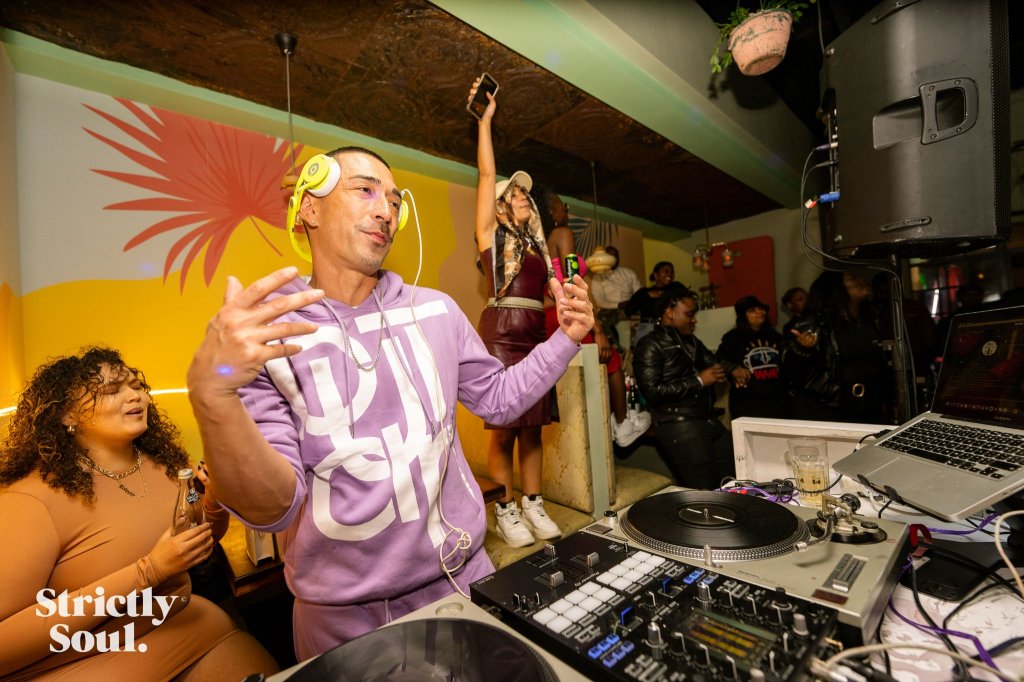
It’s 2020, the world has been struck with Covid, and no one knows what the future is looking like. In South Africa some of the strictest lockdown laws and regulations are enforced upon us. The entertainment sector is in a panic because how are people and businesses meant to sustain and survive?
We see creatives turn to social media to bridge this gap, keep relevant and explore new ways of keeping entertainment alive and their brands. One of these creatives is prominent and established hip-hop DJ Akio. Akio decided to use his Instagram to host live sessions where he would play r&b sets for the people watching as he broadcasts from his rooftop. The lives received such positive reception that once the lockdown laws became more lenient, Akio and his team were able to host the event live since October 2020 and the growth has been incredible.
Today in 2024, 4 years later, we see Strictly Soul selling packed out shows, travelling across and outside of the African continent, and filling the people’s hearts and souls with the sounds of beautiful, sing-along and fresh new music every week. Strictly proves the theory that women love RnB like men love hip-hop, true because there is no shortage of gorgeous women to be found at any point and maybe it started out because it used to be free for ladies but the truth is that they’ve worked on creating and be a safe space for femme bodies and allowing them the freedom to party in peace.
This growth of theirs has also led to Strictly Soul hosting live acts for a more intimate fan experience, where local R&B acts perform a 45min-hour set and finish the night off with a QnA. Acts have included Filah lah Lah, Nanette, Ricky Tyler, The Big Hash, Rowlene, and international acts 9th Wonder & Xavier Omar. From an online IG live experience to now touring Strictly Soul to different countries within and outside of the African continent, the rise of Strictly Soul is slowly becoming a global phenomenon.
The only thing about Strictly Soul that’s an issue is that it’s grown so popular the capacity of the venue, La Parada is not enough for all the attendees, which leads to a slow bar turnover time when ordering drinks so I’d advise to always come early and make your first round order the second round order, third round, fourth round and etc. so you can order and pay in bulk and go on with your night.
Now as I’m known for being In The Streets & Industry I couldn’t just give you my review of Strictly Soul, but I got a chance to ask founder, Akio Kawahito, a dfew questions about Strictly Soul and it’s future.
INTERVIEW WITH AKIO KAWAHITO
How did the concept of Strictly Soul come about?
I’ve been sitting on the concept since 2017, from my KoolOut days. I always wanted to be more behind the scenes putting everything together instead of being seen as the superstar DJ and at the time I was playing around with RnB and noticing how the women love it but my personal career started taking off and I had no time to implement the idea. Come 2020 Covid hits so Beno & I started doing live RnB rooftop streams with my DJ equipment every Sunday and that’s how the concept of it started.
As a strictly r&b, soul, neo-soul party did you ever think it would grow to be this big?
No, lie…but yes, I did, maybe not this big across Africa but again my place in culture in South Africa has always been doing something different. At some point people don’t see it because everyone starts to do the same thing but I’m always starting something different. When I was with KoolOut in 2008, a time when hip-hop wasn’t necessarily booming and mainstream in South Africa, we bought in artists like Blu & Exile, Baboo, People Under the Stairs and that grew into bringing out Mick Jenkins to South Africa for the first time.
Even when talking to my team in the begin phase of Strictly Soul I would tell them, “Hey guys it’s only going to be a matter of time til people start saying what we’re doing won’t work or won’t last and then eventually start doing what we’re doing so stay focused and don’t let it distract you from our vision.”.
I knew it would work because I did my research. There were no RnB parties in South Africa and because I’m a touring DJ, I also got to see it was the same thing across Africa. The only party I knew of was Soulful Sundays, which was more for your aunties and uncles, so I knew there was a missing space in the market and how to occupy it successfully.
Most people know you and recognise you from your hip-hop background and history, how did you make the switch from, “in the streets”, music to, “in the sheets”, music?
In the sheets music, hahaha. That’s hilarious I’m going to steal that for a caption. I’ve always been an RnB thug; I just didn’t get into it because growing up there were no RnB DJs just hip-hop DJs. As a young kid I always loved RnB and only in high school and university did I start going into hip-hop, but my passion has always been RnB. That’s why when you look at Strictly Soul compared to other RnB parties they don’t have the catalogue, knowledge and love for RnB and that is what makes us stand out.
Even with hip-hop growing up I never wanted to become the bitter old head complaining about the new music but around 2019 hip-hop started seeing a dip and relying on the women to carry it and with that people were complaining that he classic RnB we love was dying but modern RnB was on a rise then and I leaned into that as well which helped me be able to bridge the gap between the young and old and create a community within Strictly Soul instead of having the old heads fighting the new kids on the block.
Now unfortunately due to technology hating on a n*gga I had to end the interview here but hope that you find some time to go and experience Strictly Soul for yourself and immerse yourself in the beautiful and loving community that it is.
 FRATPACKER WORLD.
Leave a comment